
Utah City Directory Holdings
Utah has no single catalog with a complete annual directory run for every town. The clearest digitized starting point is the Marriott Library collection, whose documented examples include Salt Lake, Ogden, and Logan or Cache volumes from the 1917–1919 period, plus one suburban Salt Lake volume from 1959. Those are examples of surviving items, not proof of continuous coverage. A search works best when the place, likely year, and printed title are checked together.
| Collection | Years | Where Held | Access |
|---|---|---|---|
| Utah City Directories, Marriott Library | Selected 1917–1919 examples; one 1959 suburban volume | Marriott digital collection | Browse scans and OCR by title, year, and page; runs are not continuous |
| Utah Historical Society Library | Collection-specific; full directory span not stated | UHS library and research staff | Ask by phone or email about unscanned holdings |
| Salt Lake City Public Library Archives | Varies by local series | Periodicals Archives and Special Collections | In-person microfilm readers and scanners; some items stay in the building |
| Other Utah public and local-history libraries | Municipality-specific; not gathered in one statewide catalog | City or county library | Ask staff to check shelf, microfilm, and local catalog records |
The 1959 volume covers Bountiful, Granger, Holladay, Kearns, Midvale, Murray, North Salt Lake, Sandy, Taylorsville, Union, and Woods Cross. A Salt Lake title can therefore describe nearby suburbs as well as the central city. No verified first year, last year, or full uninterrupted run was found for Utah as a whole, so missing years should remain gaps in the research record rather than guessed dates.
Selected Utah City Directory Pages
The Marriott Library’s Utah City Directories Collection is a set of digitized items that can be browsed by title, year, and page. It includes residents, streets, businesses, organizations, and institutions. A result may offer both OCR text and a page image, but the catalog does not show an unbroken annual series for each city. Record the exact title and page that produced a name so another reader can return to the same item.
One scanned Utah directory page in the Marriott viewer makes the layout easier to inspect than a search-result snippet.
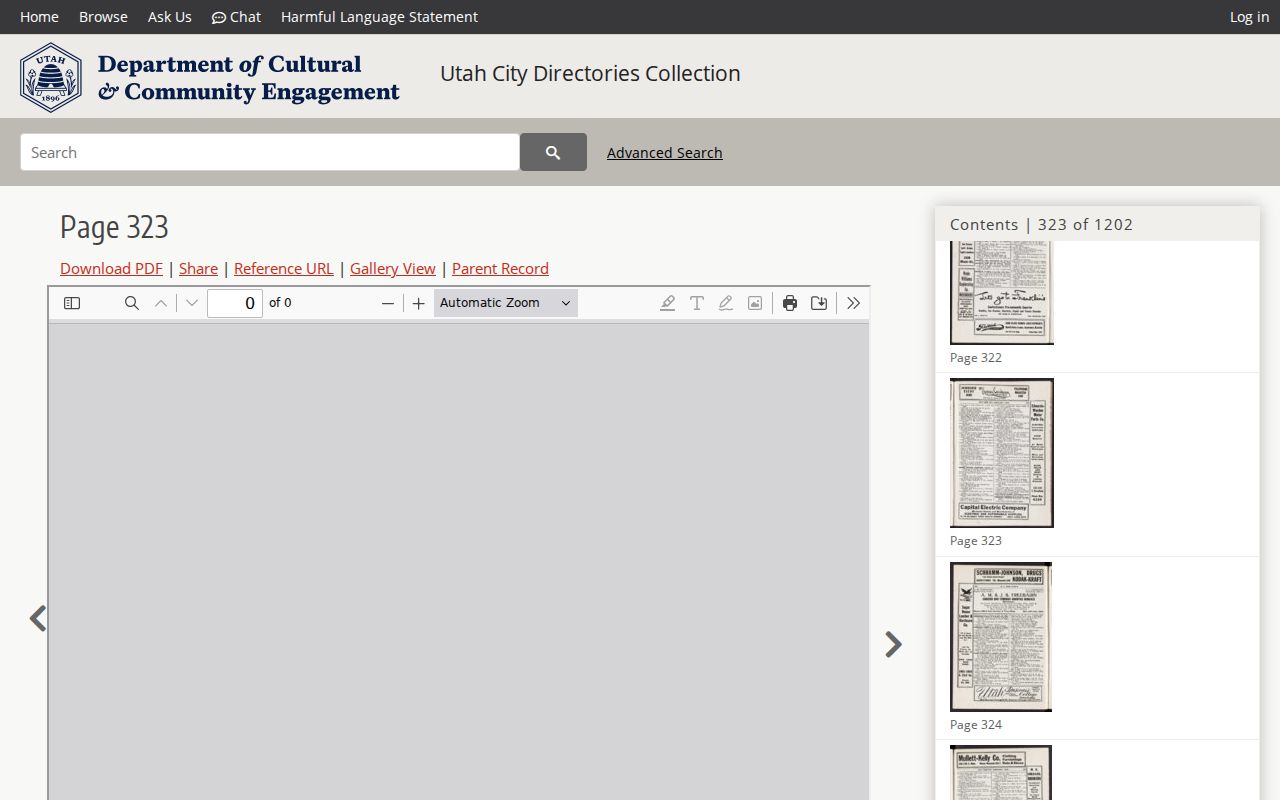
The image is the evidence to check when OCR splits a line, drops an initial, or reads a name beginning with Mc as Mac, or the reverse. A text hit can point to the right page while still misreporting the letters around it.
Before relying on a result, note whether it is an alphabetical entry, a street-index page, a business listing, or an individual scan. The page image can show how a line continues across a column and whether an initial belongs to the next name. Save the image citation with the printed title and page number, since a search snippet alone may not preserve the layout or the exact spelling.
Utah Historical Society Directory Shelves
The Utah Historical Society Library collection page lists maps, newspapers, books, pamphlets, manuscripts, photographs, yearbooks, telephone directories, and microfilm. These holdings can help when a city directory is unscanned, a newspaper notice supplies a second address, or a map is needed to place an old street. Ask staff about a specific town, family name, business, and date range instead of assuming every item has a name index.
When a likely directory year does not appear online, ask whether a print or microfilm copy exists and whether the title is cataloged under a city, county, publisher, or broader regional name. A targeted question can also surface related yearbooks, telephone books, maps, or newspaper reels that are not indexed by resident name.
Use the Utah Historical Society library and collections page to plan a question about access to a specific holding.
The Society invites research questions at history@utah.gov and 801-245-7227 or 801-245-7292. A call or email can establish whether the material is digitized, restricted, or available for in-person review.
What a Utah Directory Entry Reveals
A Utah city directory entry can combine a person’s name, relationship note, address, and business description, with the street index and page number providing another route through the volume. Some books also show a firm or telephone number. The exact fields depend on the publisher and edition, so copy what is printed before trying to interpret it. A spouse or widow notation can support a family-history lead, but it does not confirm that two people share a home today.
| Entry detail | What to record |
|---|---|
| Name and relation | Printed name, initials, honorific, spouse or relationship abbreviation such as “wid” |
| Address | House number, street wording, and any direction or unit as printed |
| Work or business | Occupation, business description, firm name, and telephone when shown |
| Entry route | Alphabetical listing, street-index placement, page number, image, and OCR result |
| Owner or renter marks | Record only if present and defined by that volume; observed “r” and “b” clues are not universal owner or renter codes |
Three terms help keep the search straight. They describe different ways to use a book, not a promise that every Utah volume contains each section.
- Criss-cross directory
- An address-to-name arrangement that lets a reader start with a street or building. A complete Utah criss-cross series was not located in the reviewed official collections.
- Householder index
- A name-based list of household heads that points to an entry or page; check the volume’s label and scope.
- Abbreviation key
- The publisher’s explanation of short forms and marks, often printed near the front or back of a volume.
In the observed Utah page, “r” marks a residence or rents context and “b” appears with boarding or boards. Those are page-level conventions, not universal rules. Note: Check the printed key and the surrounding entries before expanding an abbreviation into a family-history fact.
Salt Lake Archives for Utah Directories
The Salt Lake City Public Library Archives offer a local research path beyond digitized pages. Periodicals Archives on Level 2 holds historic newspapers on microfilm, local-news clippings, and magazines. Special Collections on Level 4 holds local-history books, ephemera, photographs, maps, slides, Masonic Library Records, and library scrapbooks. Readers may use scanners and microfilm readers in person, while most fragile material must remain in the building.
The library lists walk-in research help on the third Thursday of each month, 5–7 p.m., at the Level 2 Periodicals Desk. Its HeritageQuest access page points cardholders to genealogy resources, while Digital Sanborn Maps can help place a building or street. These tools add context; they do not replace the original directory image or establish who owned a home.
The Utah State Archives is a separate route for government material. Its digital collections include county and municipal series, but the description page determines whether images are available. The city and county records guide helps identify a series by jurisdiction and record type. A historic city title may sit in a library, while a clerk’s register or municipal file may be described by the Archives under its creator.
Utah Street Names in Old Directories
A person who seems to vanish may have moved, but a street can also change names. The Utah Historical Society’s account of its Salt Lake City and Ogden Sanborn map release records a local example: Social Hall Avenue became Motor Avenue in 1926 and returned to its former name by 1950. Search both names when a family address falls in that span, and preserve the wording printed in each book.
Municipal edges can shift the place label as well. The 1959 suburban volume spans several communities around Salt Lake, so a family may appear under a broader directory title than the modern city name. Salt Lake’s atlas plats can help check street closures, widening, vacations, dedications, and lot context. A current map alone cannot settle what a historical address meant.
Tracing Utah Households Across Directory Years
Family research works best when each Utah directory entry is treated as a dated clue. A run may skip years, change its street-index layout, or cover suburbs under a regional title. Pair an available edition with the nearest census schedule, then compare the names, address, family relationships, and place labels. The records may not line up exactly: census geography follows the enumeration year, while a printed directory reflects its publisher’s coverage and deadline.
- Choose a city and likely period, then save the directory title, year, page, and image.
- Copy the name, household notation, business, and full address exactly as printed.
- Check the closest surviving directory before and after that entry for a move or spelling shift.
- Compare the household with a census schedule from a nearby enumeration year, keeping its place boundaries in view.
- Use a newspaper, cemetery record, map, or local archive to test a move, death, or change in household.
The FamilySearch Utah County guide describes records from 1850–1962, including deeds from 1856–1931 and other local series. That is a Utah County resource, not a statewide directory run. If a name drops out, a move, death, changed spelling, unlisted household, or missing volume are all possibilities; a second source is needed to tell them apart.
For each household, keep the exact name form, address, page, year, and source image together. Then compare separate records without blending their roles: a census lists a household on its enumeration date, a directory reflects its publication cycle, and a map locates a structure or lot. If an expected year is missing, mark the gap and use another surviving source rather than filling it by guesswork.
Utah Directory Entries and Property Ownership
A city directory records an association between a name and a place for a publication period. A deed records a transfer of property, while a tax parcel describes the assessor’s account. These sources can agree, but they answer different questions. A person at an address may be a resident, relative, boarder, or business contact; the printed line alone does not prove ownership or the full household.
When an old address needs a modern parcel match, the Utah street directory page follows address-keyed records. When a historical name must be checked against current public records, the Utah resident lookup page covers that separate task. Keep the directory citation, parcel record, and deed reference distinct so a useful lead does not turn into a claim the source cannot support.