
Utah Records for One Name
Utah has no single official residential directory. A useful resident lookup joins separate records without asking any one source to prove more than it contains. A parcel map can connect a named owner to a site address, but an owner may be a trust, an organization, or a prior owner in a lagging county file. A court entry records a party in a case, not necessarily a present address. Voter and professional records answer still different questions. Keep the type and date of each address beside the name.
| Record | What It Confirms | Where | Access |
|---|---|---|---|
| Parcel and deed records | Parcel number, owner field, situs address, legal description, or recorded transfer | Utah State Parcels and county assessor or recorder | Map and county access; county detail varies |
| Voter information | For a voter, registration status and election location; a separate public file has defined fields | Vote.Utah.gov and county clerk | Self-lookup online; bulk file by formal request |
| Court case index | Public case, party, filing, and case-history details | Utah Courts Xchange | Guest or paid access; terminals and clerk requests are alternatives |
| Vital records | Birth, death, marriage, or divorce event and named relatives where the record permits | DHHS Vital Records, State Archives, county clerk, or district court | Copy eligibility, date limits, and ID rules apply |
| License or entity record | A regulated credential or business affiliation, not a home address | Utah DOPL license lookup | Public lookup; field and history depend on record type |
Start with the record that fits the question: a case number with the court, a family event with Vital Records or an archive, a parcel or address with county property records. Voters should use the self-service portal. Compare two independent details before treating a common name as a match.
Utah Court Records Search
Xchange covers public Utah district and justice cases, searchable statewide, by county, or by court. A result list is capped at 500; court scope, case number, or a wildcard can help narrow common names. Short names and wildcard behavior follow the court’s search guidance.
| Xchange field | What to enter or choose |
|---|---|
| Court scope and type | Jurisdiction: District Court, Justice Court, or both; Search Type: all court cases or judgments entered only. |
| Case number | Known case number; it is not unique statewide. |
| Surname or company | Last Name/Company; exact match unless a wildcard is used. |
| First name | A first-name wildcard such as John* can catch middle names and suffix variations. |
| Case type and scope | Choose a case-type code, then Statewide, county, or a particular court. |
| Birth date and citation | Birth date is often available only for criminal defendants; a citation number may need its location to narrow it. |
| Date panel | Open Show Date Range Panel, then enter the date range that appears. |
Guest access and paid subscription are both available. Public terminals at most district-court locations and the clerk are alternatives when online access is insufficient. For a copy, provide court, case number, party, record type, and whether an ordinary or certified copy is needed.
A sample result row can show county, court location, case type/code, case number, filing date, party names, birth date when present, party code, and case-history or document links. Party details may include a filed address. Case history can show counsel, filings, hearings, judgments, outcome, charges, plea, disposition, judge, due documents, balance, proceedings, and minutes. Public electronic documents have a per-document charge.
Older court records may move to the State Archives after about 50 years. Divorce decrees, naturalization, name changes, probate, and criminal files are common requests; some series are indexed, others require a series search.
The Utah Courts Xchange portal is a case-search entry point, not a case result.
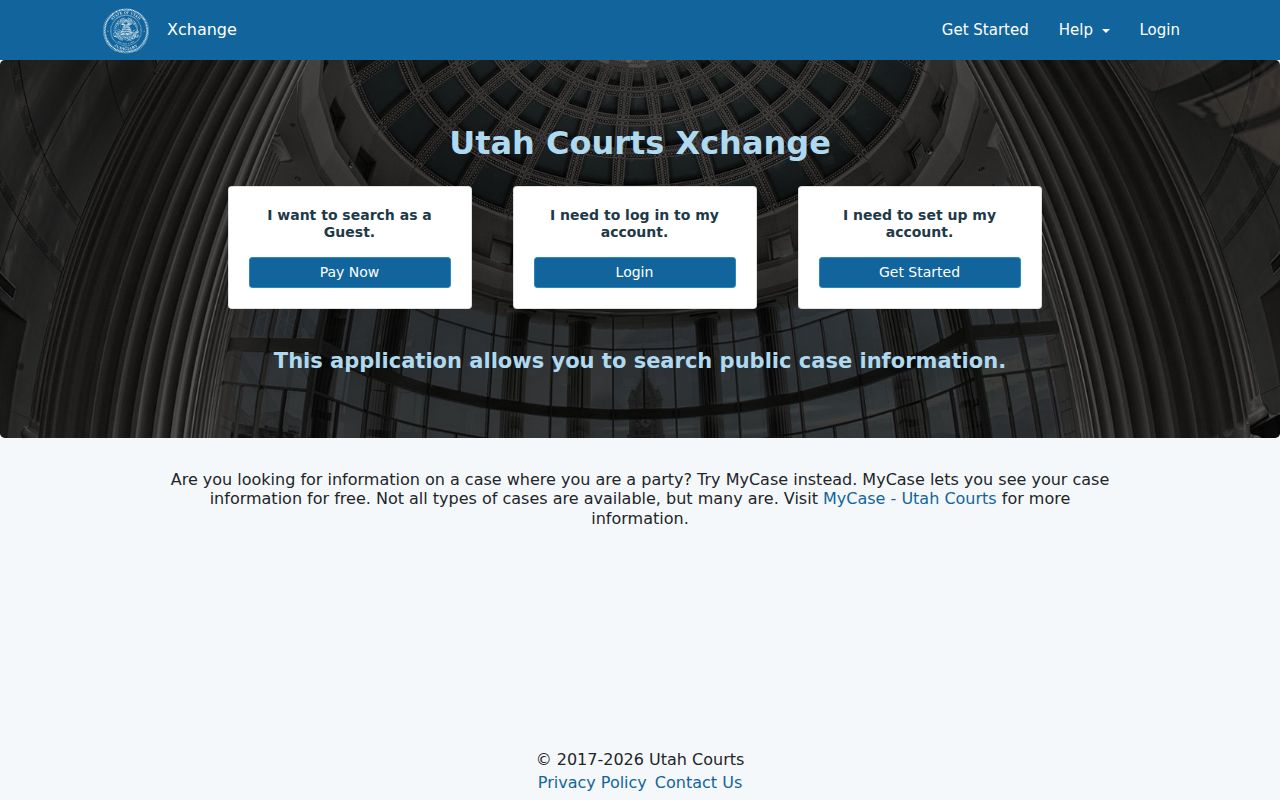
A portal screen can begin a name search, but the filed documents and clerk remain the route to a case record.
Utah Vital Record Routes
Utah DHHS Vital Records holds births and deaths from 1905 forward, and marriage and divorce certificates from 1978 through 2010. Births less than 100 years old, deaths less than 50 years old, and marriages less than 75 years old are generally restricted. Requester relationship or legal role, proof, and acceptable ID also determine eligibility.
Use the official order page and current forms for event details, relationship proof, and identification. A birth application requires one primary photo ID or two secondary IDs under the form rules. Check the live fee schedule and processing estimate before applying.
Order online, through a local health department, or by mail to PO Box 141012, Salt Lake City, UT 84114-1012. The state office does not advertise a regular public counter; health departments are the in-person route. Vital Records lists 801-538-6105 and vrequest@utah.gov.
Open the Utah Vital Records forms page to review the applications that support a certificate request.
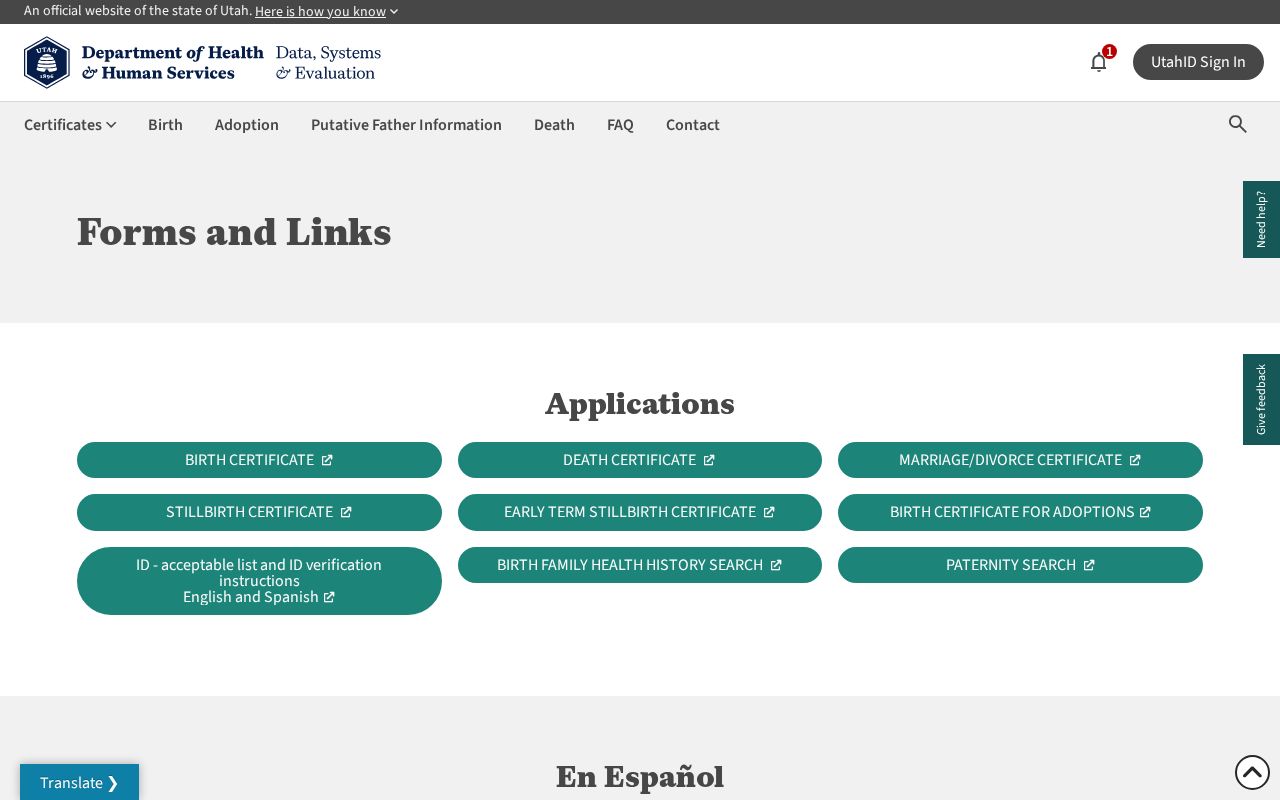
The application forms show which event details, relationship proof, contact fields, and identification the custodian needs.
For marriages outside state coverage, ask the county clerk; for divorce files, ask the district court. The Archives’ birth index is a finding aid, not a certificate. Archives, county collections, microfilm, and newspapers may help with older events. A divorce certificate is not the full court file, and no index match does not prove no record exists.
Verify One Utah Resident
Use two independent anchors, such as a full name plus a city, family link, address, or case number. Record county, parcel or serial, legal description, address type (situs, mailing, filed, or historical), and source date. County and portal updates vary, so keep address types distinct.
- Copy the name as shown, including middle initial, suffix, or former name.
- Narrow by parcel, city, family date, or case number; label the address as situs, mailing, filed, or historical.
- Search Xchange spelling variants and compare court, case type, filing date, and party details.
- Check vital-record date and requester rules, then save the source, date, and record ID before requesting a copy.
- Docket
- The court’s running case record, with entries for filings, hearings, orders, and other events.
- Index vs. image
- An index points to a record and may show a few fields. An image is a view of the filed document, when public and available.
- Certified copy
- A copy issued by the custodian with a formal certification that it is an official copy.
For an old address, a Utah city directory can support a dated association, not a present address.
Utah Voter Records Boundaries
Vote.Utah.gov lets a voter check their own status and polling place; it is not a resident directory or proof of current address. A separate public file can include legal name, voter ID, age range, residential and mailing addresses, county, precinct and district, party or unaffiliated status, active status, last update, and vote history. Participation does not reveal vote choice.
The public category omits Social Security and driver/state-ID numbers, full birth date, phone, email, signature, and protected addresses. Eligible voters can seek an at-risk designation with documentation through the county clerk or Lieutenant Governor by mail, email, or in person; see the designation form. A blank result may reflect protection or a status transition.
Bulk data is requested through a separate Utah voter and election data page, not through the self-lookup screen. The state page describes a May 2026 transition, a $1,050 one-time statewide file, tab-delimited delivery of about 150 MB, and separate county or district requests through county clerks. Treat the self-lookup and bulk file as different access paths, and do not republish protected fields or use the request to get around a confidentiality rule.
The Vote.Utah.gov portal is designed for a voter to check their own status or polling-place details.
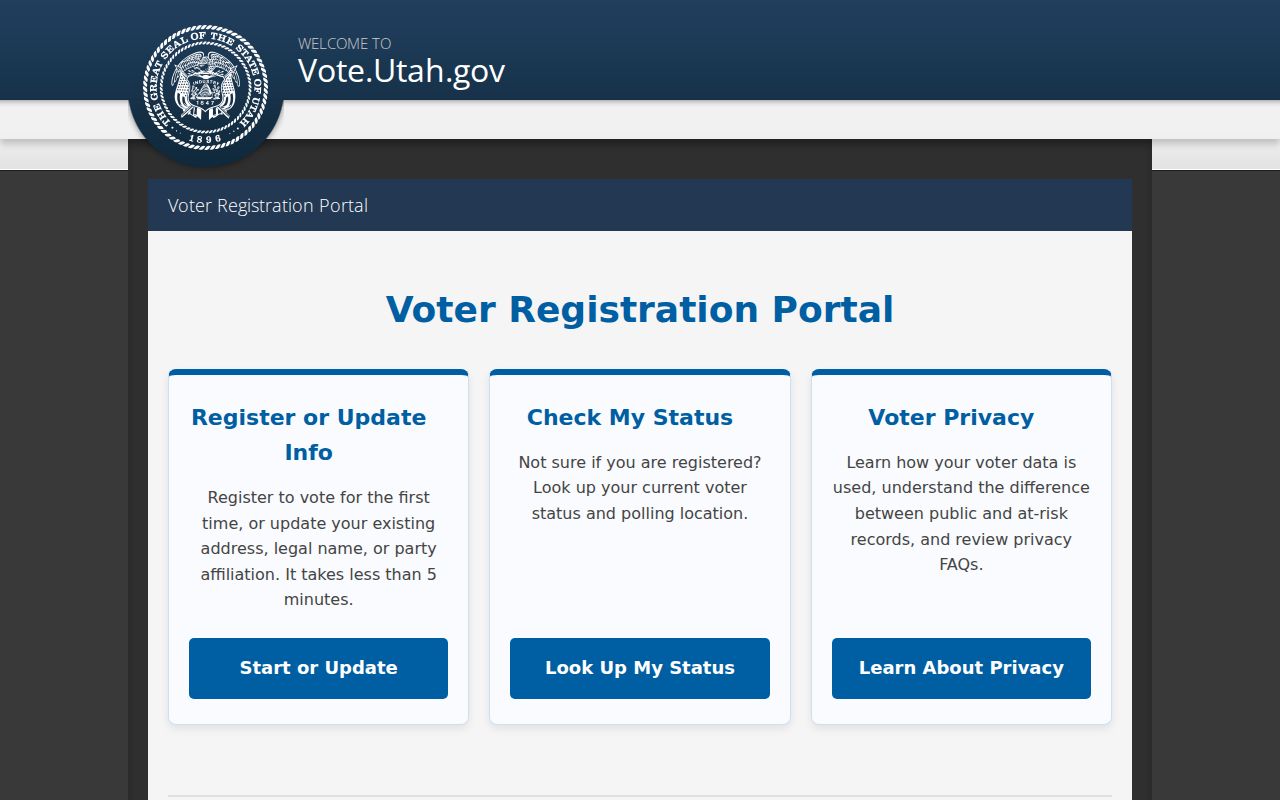
The portal presents a voter-facing check, while bulk election records follow a separate request path and privacy rules.
Utah Names That Collide
Common names create false matches. Check initials, middle names, suffixes, former names, and spelling variants; Xchange wildcards such as Doe* and John* can help, while short names under three characters need no wildcard. Compare independent fields such as age range, county, case number, parcel description, and address type. A company or newspaper clue may add context, but a business address or OCR transcription is not proof of residence. Keep possible matches separate from custodian-confirmed records.
Protected Utah Resident Addresses
Xchange excludes sealed and expunged cases, adoption, civil commitment, juvenile delinquency, child welfare, and termination-of-parental-rights matters. Under UCJA 4-202.02, private civil-family categories include divorce, separate maintenance, grandparent visitation, temporary separation, marriage adjudication, civil stalking, guardianship, conservatorship, cohabitant abuse, custody/support, UCCJEA, UIFSA, and paternity. Some histories, public-hearing minutes, judgments, orders, decrees, and appointment letters may remain public unless separately restricted. Do not infer a sealed record from a missing result.
Safe at Home provides qualifying participants a substitute address and mail forwarding while their location stays confidential. Do not reconstruct it from parcel, voter, court, or social clues. DMV files have a separate DPPA and Utah-law boundary and are released only through limited routes.
Utah Resident Lookup Limits
GRAMA requests go to the agency that holds the record and should identify the requester and describe the record clearly. The Archives says normal responses are within ten business days, or five for a qualifying public-benefit request; inspection is free, while copying and suitable staff time may be charged. Start with the Open Records Portal, the GRAMA form, or the agency records officer. Utah’s stalking statute addresses repeated conduct that creates reasonable fear for safety.
Lawful use. Use public records for a specific, lawful personal question, and respect every redaction and confidentiality rule. Never use a search to stalk, harass, threaten, or intimidate anyone.
If online access fails, use a court terminal or clerk, health department or mail route, county clerk, Archives, or library as appropriate. Label every address by type and date; stop at protected information.