
How to Search the Utah Residents Directory
Utah has no single official list of everyone who lives in the state. A county assessor records parcels and tax owners. Courts keep case indexes. Election offices hold voter records under access rules. Libraries and archives preserve older directories and local records. Each source answers a different question, and each has gaps.
Begin with the detail you already know. Keep the name or address in its original form, note the county and year if you have them, and move from one record to an independent source. The steps below work as a first pass across Utah’s split record system.
- Match an address to a parcel in Utah State Parcels, then follow the county link for the assessor or recorder record.
- For a court lead, search Utah Courts Xchange by name and narrow the court or county when the name is common.
- Use Vote.Utah.gov only for its individual registration and polling-place service; public voter data has a separate request path.
- For an earlier household, search a dated city directory, then check its address against a deed, map, or newspaper.
- If a public record is not online, ask the office that made it or submit a focused GRAMA request.
Utah Residents Directory: Office Routes
State agencies supply shared entry points, but many Utah records start with the local office that made them. The State Archives serves as a historical and request-routing resource; Vital Records handles the statewide certificate periods; county clerks, assessors, recorders, courts, and city records officers retain their own series.
There are 29 counties, and recorder indexes do not share one online start date. The Utah county-recorder directory helps identify the right office when the county is known. For an address search, follow the county handoff in the Utah street directory.
The Archives is useful both for its catalog and when an older series has no scan. Search its research guides and digital collections first; when a description points to paper, microfilm, or an unindexed series, call the reference desk or plan an in-person visit. For a record held by a present-day agency, use that agency’s own records officer or the statewide portal to route a GRAMA request. A catalog hit identifies a collection; it does not mean every page is available online.
Utah State Archives
Historical records and finding aids
Reference room assistance
801-531-3847
Utah Elections
Individual status and polling place
County clerk contacts for local records
See the statewide clerk directory
Utah County Land Records
County parcel and deed systems are not interchangeable. Utah County Land Records links owner, address, serial-number, subdivision, valuation, tax-history, and document searches from one menu. Salt Lake County splits its public parcel search from Data Services, where image and chain-of-title access may require payment. Weber County also separates free parcel search from paid title abstracts.
For other counties, use the statewide recorder list to find the local starting point, then ask whether the online index includes images or only a record summary. The statewide parcel map can locate a parcel across Utah, but it does not certify ownership or replace the county recorder’s instrument record.
For a Utah residents directory search, the statewide map only locates a parcel; the county assessor and recorder remain the source for current fields and recorded instruments.
Utah County’s map can search by an address, owner, serial number, city, or Public Land Survey System section, township, and range. It also shows historic parcel shapes and deed points. The historic date means when that shape was entered into the viewer, not the deed’s recording date. Salt Lake County’s public parcel page can report data at least a day old, so save the source date and verify the instrument with the recorder when the distinction matters.
Check Utah Court Records by Name
Utah Courts Xchange searches public district and justice court case information. Its search can be limited by court scope, county, case type, case number, or party name. A first or last name can use a wildcard to include middle names, but results may stop at 500, and a common name can still produce the wrong person.
Most district-court information is available from the late 1990s onward, while justice-court conversion dates vary. Courthouse terminals and the clerk are useful next stops when the web result is thin. Older series may have moved to the State Archives after roughly 50 years. Sealed, expunged, juvenile, adoption, and other restricted records do not appear as ordinary public matches.
Record the court, case number, filing date, party role, and exact search terms that produced a possible match. If Xchange does not return an older or narrow record, a clerk can explain whether it remains at the courthouse or moved to an archival series. Ask for a specific document or case history rather than treating a name result as a full account of someone’s life.
Current Utah Resident Directories
Current records can connect a name with property, a court filing, or a voter record, but no one row stands for every resident. Use each source for its stated purpose and record whether an address is a parcel location, mailing address, or address filed in a case.
| Record source | What the entry can show | Custodian | Route |
|---|---|---|---|
| Assessor parcel roll | Tax owner, parcel, situs and mailing address | County assessor | County search or parcel map |
| Recorded document index | Parties and details for a deed or lien | County recorder | County portal, counter, or request |
| Public court index | Parties, filing dates, and case activity | Utah Courts and court clerks | Xchange or courthouse terminal |
| Voter records | Limited public fields and participation history | Lieutenant Governor or county clerk | Self-lookup or separate data request |
| Printed and digitized directories | A household or business at a dated address | Libraries and archives | Search online or consult the collection |
Use the county assessor when the question is about a parcel owner, and the recorder when the question is about a recorded transfer. A court name search answers a case question; it does not establish a current home. The resident-lookup page compares those name-based sources and their limits.
Utah Voter Records and Requests
Vote.Utah.gov lets a person check their own registration status and polling information. The public voter-list process is separate. Utah’s election office describes a statewide file and directs county or district list requests to county clerks. Public fields can include a name, address, age range or year of birth, party or status, districts, update date, and vote history.
Vote history records participation, not a person’s choice on a ballot. Full birth date, state ID, Social Security number, phone, email, signature, and protected at-risk information are withheld. A missing address may reflect an active protection or a data limit, so do not try to infer a private location from other records.
The statewide registration file is a separate request from the voter status page. The Lieutenant Governor’s office describes the post-May 25, 2026 file as a tab-delimited download, while county or district lists go through county clerks. Its published amount, file size, and delivery timing can change; check the current voter-data instructions before submitting. A personal status check is usually the right route for an individual’s own registration question.
A Utah Street-Name Change
Old street names can break a search even when a house and parcel remain easy to place. The Utah Historical Society notes that Salt Lake City’s Social Hall Avenue became Motor Avenue in 1926 and returned to its earlier name by 1950.
Keep the wording used in each source, then compare a directory, a dated map, and a parcel record. Utah’s quadrant systems also begin from local origins. St. George uses Tabernacle and Main as a grid origin; Santa Clara counts from St. George, while Hildale’s grid is tied to Colorado City, Arizona. Those local patterns are useful when a number or direction seems odd.
Utah GRAMA Records: Request Routes
Utah’s Government Records Access and Management Act, or GRAMA, is the route for requesting a public record held by a state, county, city, or other government office. The State Archives Open Records Portal can route a request to a records officer. Email, fax, mail, and in-person requests are also available through the agency that holds the record.
Name the office, record type, person or address, and useful date range. A focused request helps the custodian tell a public record from a protected one and find the correct series. Inspection is generally different from obtaining a copy, and authorized costs can apply. The Utah Open Records Portal also describes routing and retention.
The state portal shows how to find a records officer and route an online request.
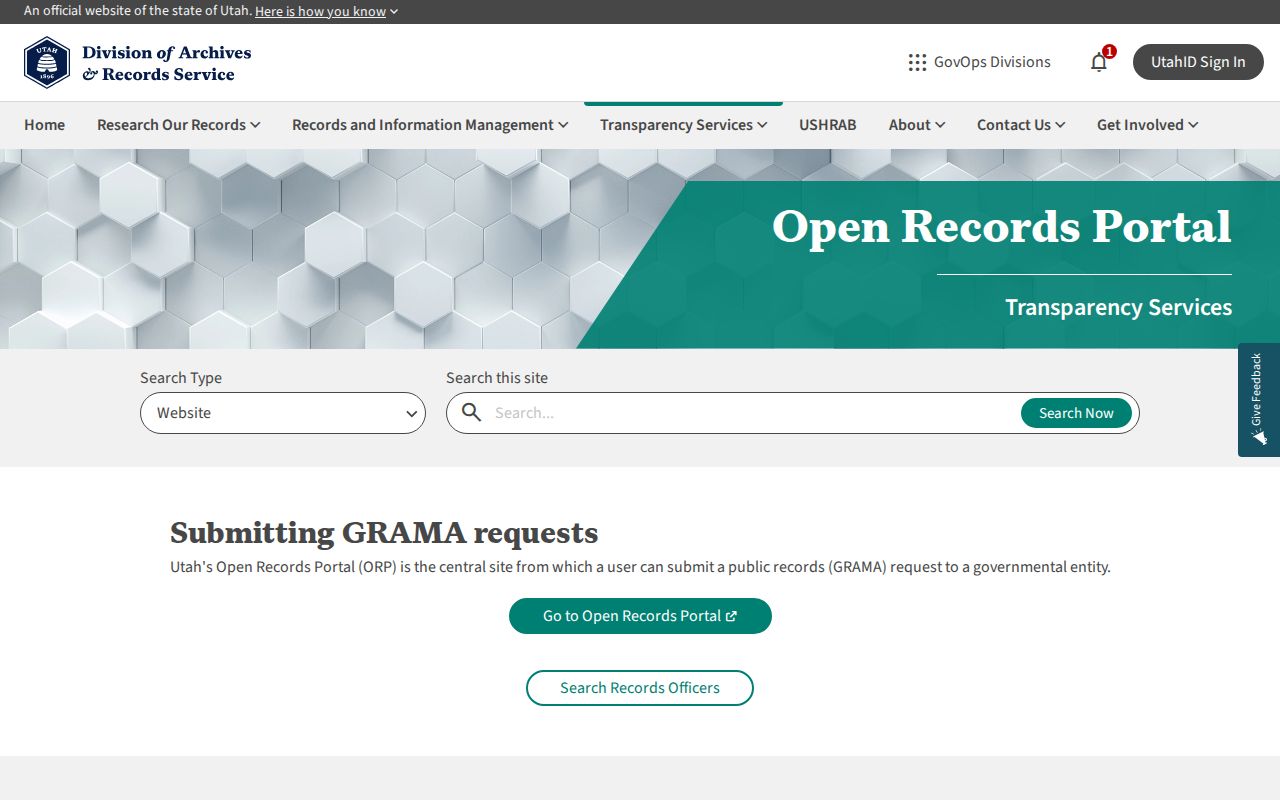
Use the portal to find the right custodian, then describe the record you need rather than asking an office to search every system for a person.
Historical Utah Resident Directories
The Marriott Library’s digitized Utah City Directories Collection includes selected Salt Lake, Ogden, and Logan or Cache examples from 1917–1919 and a suburban Salt Lake volume from 1959. These are useful dated snapshots, not a complete year-by-year run. The Utah Historical Society and local libraries hold other city directories, phone books, maps, and newspapers.
A directory entry can connect a person with a street, business, or household for one year, but it does not prove property ownership or current residence. For the collection list, OCR cautions, and shelf routes, see the Utah city directory collections.
Utah Directory OCR and Archive Shelves
Digitized text is a finding aid, not always the final word. In an older city directory, line breaks can split an address or name, and initials or Mc/Mac spellings may be read poorly. Compare the OCR against the page image and search a street index as well as the alphabetical name list.
When a scan is missing, the Utah Historical Society Library lists newspapers, maps, yearbooks, telephone directories, manuscripts, photographs, and microfilm. Salt Lake City Public Library Archives has newspaper microfilm, local-history material, scanners, and microfilm readers for in-person use. Other towns need their own library or historical-society search because Utah has no single catalog of every local collection.
At Salt Lake City Public Library, the Periodicals Archives holds newspaper microfilm and local-news clippings, while Special Collections keeps local-history books, photographs, maps, scrapbooks, and other material. Readers can use scanners and microfilm equipment, but fragile items usually stay in the building. Ask the library about the collection’s current access before traveling, and note the shelf, roll, or page reference so another source can be checked against the same item.
Utah Resident Records: Owners and Occupants
A parcel record names the person or entity tied to a tax parcel. That may be an owner, trust, business, or mailing contact; it does not list every person who lives there. A voter address is a public field under its own rules, and a court address is what a party filed in a case. Keep those labels separate.
| Official record | Best use | What it cannot settle |
|---|---|---|
| Assessor or parcel map | Find parcel, owner field, and situs address | Who occupies the home |
| Recorder index | Follow a recorded instrument or deed | Every person in a household |
| Voter file or case index | Check a public record field or filed party detail | Current presence at an address |
- Parcel
- A land unit the county tracks for tax and map purposes.
- Situs address
- The site address tied to a parcel, distinct from a mailing address.
- Index
- A name or property pointer to a record; the full document may be separate.
Utah Vital Record Time Limits
Utah’s Vital Records office holds birth and death records from 1905 forward and marriage and divorce certificates from 1978 through 2010. Older public-access periods are 100 years for birth records, 50 years for death records, and 75 years for marriage or divorce records. A historical index and a certified certificate are different products.
Current certificates are limited to the person named, immediate family, a legal guardian, or a designated legal representative, with proof of relationship or legal need and identification as required. Orders can go online, through a local health department, or by mail. County clerks hold many marriage records outside the state period; district courts hold divorce files outside the certificate window. Check the live order page for current fees and processing time.
A request form asks for the event date and place, the person named, the requester’s relationship, contact details, the reason for the request, and the number of copies. Birth and death forms also ask for identity details and supporting identification. For older material, the State Archives’ birth index and county collections are finding aids, while the record itself may sit with a county clerk, court, or historical collection. If the search finds no certificate, ask the right custodian about the relevant year rather than assuming the event was not recorded.
Utah Parcel and ZIP Records
The statewide parcel viewer accepts a county, street address, city, or ZIP and also supports map browsing. A parcel click is a way to locate a county record, not a statewide title finding. The UGRC parcel and address layers bring local data together, but update dates differ by county.
| County | Select a Utah county before narrowing the map. |
|---|---|
| Street address | Use the local address form, including direction or unit when known. |
| City and ZIP | Useful map filters, but neither one proves a legal city boundary. |
| Find or map browse | Open a parcel, note its ID, then check the county custodian. |
Utah’s ZIP polygons are approximate delivery areas. They can cross a city or county line and may change as postal geography is updated, so keep the date and source with any result.
Utah Resident Records and Civic Groups
Neighborhood records can help place a street in its civic setting. Salt Lake City’s community-council registry and map show recognized councils and resident-representation areas. They can point toward meeting agendas, newsletters, and planning records, but they are not a roster of everyone who lives nearby.
The state HOA registry searches an association’s full or partial legal name or alias. Utah began that registry in 2025, and it does not publish a member list. A council boundary, association filing, or local meeting note is context for a place. It should not be treated as evidence that a named person belongs to a group or lives in a particular home.